
Castle Rock Directory Holdings by Era
Directory records for Castle Rock read best as a series of dated snapshots. They are not a single master resident roll. The holdings split across several institutions. The Philip & Jerry Miller Library, Denver Public Library, Library of Congress, and Colorado State Archives each keep a slice of the trail. Match your question to the right era first. Then carry the collection name and its access route alongside the name or address clue you are chasing.
| Collection | Years | Where Held | Access |
|---|---|---|---|
| Castle Rock Journal | 1881-1908; directory issues 1886-1888 | DCL Archives & Local History and microfilm | Issue and page research; selected digital guides |
| Record-Journal | 1908-1952 | Miller Library and microfilm | Local notices, families, businesses, and civic events |
| Douglas County News | 1952-1966, with gaps | DCL holdings and microfilm | Digital run ends in mid-1966; check missing issues |
| Colorado business directories | 1876-1923 | DCL business-directory guide | State and local business or public-role clues |
| Local phone books and yearbooks | Phone books 1966-1973 | DCL Archives & Local History | Dated household, phone, and school leads |
| DPL regional criss-cross directories | 1924-2018; 1924-1937 digitized segment | Denver Public Library | Regional fallback; Castle Rock inclusion must be checked |
| Regional telephone books | 1970 and 1974 volumes | Library of Congress digital scans | Page-by-page regional search; not a guaranteed local run |
Mind the gaps. The Douglas County News run lacks issues across much of 1952-1964, and its digital coverage ends in mid-1966. The confirmed local phone-book window runs 1966-1973. A miss can mean a missing issue, an unlisted name, a move, or a collection still awaiting digitization. None of these collections offers a complete public Castle Rock resident roll.
Inside the Castle Rock Directory Shelf
The DCL Archives & Local History room at the Philip & Jerry Miller Library anchors any local resident lookup. You will find it at 100 S. Wilcox Street, Castle Rock, Colorado. The library lists 303-791-7323 for its local-history service. The archival guide gives 303-688-7730 for the archivist, and another press contact lists 303-688-7723. Confirm which line is staffed before you promise anyone a lookup or a same-day answer. DCL describes about 1,000 linear feet of archival material plus roughly 4,000 rare books and reference items. The 2019 catalog is searchable online. A hit, though, may describe a box, folder, scrapbook, photograph, or reference book rather than a scanned page. Ask for the collection title and the item or box reference. Also ask about any restrictions and whether the reading room takes appointments. Microfilm readers still matter for the newspaper runs, and interlibrary loan can take two to six weeks. The Philip & Jerry Miller Library local-history page is the best spot to confirm current hours. It also shows the service desk route. Its archive ties directory clues to yearbooks, obituaries, cemetery files, maps, churches, schools, and other holdings. Those include family histories, photographs, and local manuscripts. The library's local-history page also supplies the source context behind the collection material displayed here.
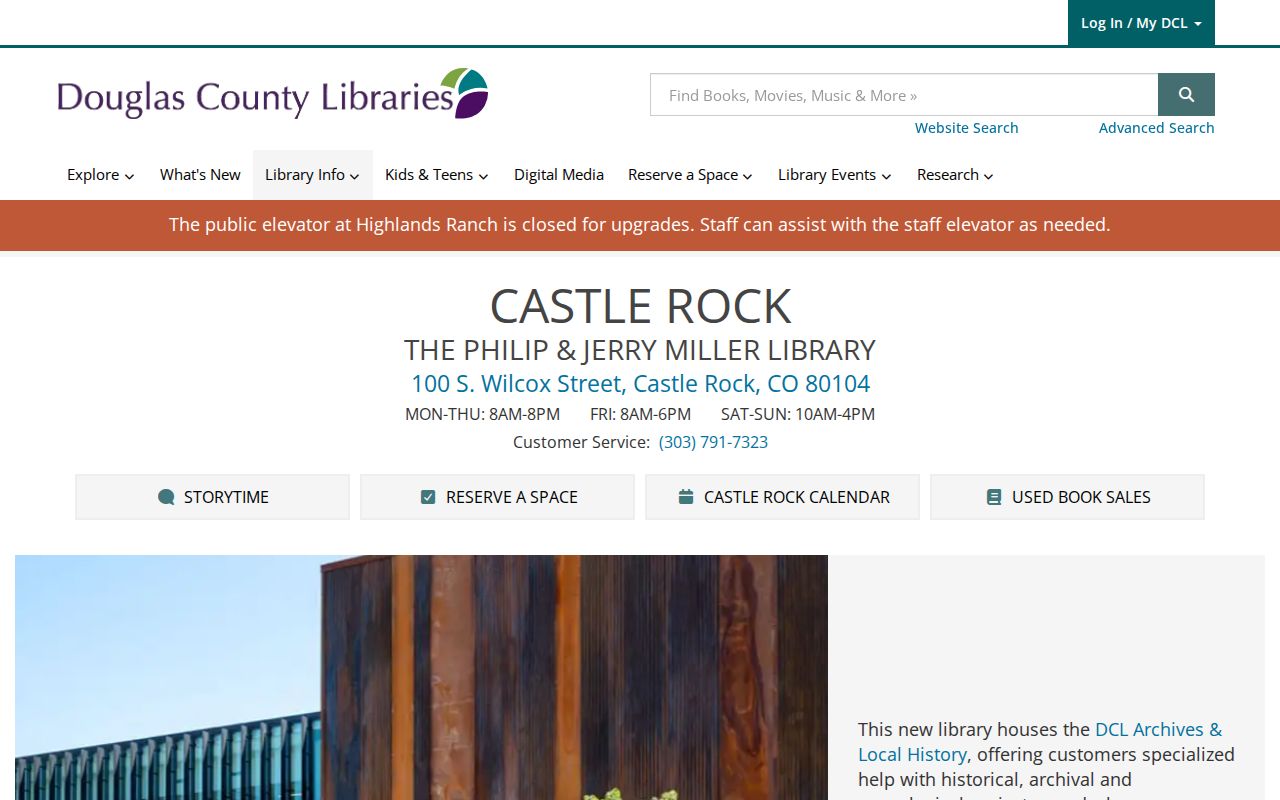
Shelf help and a catalog search belong to the same route. The catalog record locates the material, while the archivist or reading room supplies the dated page you can actually cite.
The 1886-1888 Castle Rock Directory Clue
DCL's business-directory guide points to an unusually specific source. It cites Castle Rock Journal issues dated February 7 and 24, October 13, and December 15, 1886, plus May 2, 1888. The extracted business and government directory material names Castle Rock alongside Acequia, Fonder, Franktown, Greenland, Larkspur, Parker, Sedalia, and Spring Valley. That town list helps separate a Douglas County mention from a true Castle Rock one. The samples name J.P. Adams as commissioner, Charles Anderson as trustee, B.C. Bailey as telegraph operator, G.W. Bardeley as street and water commissioner, and J.H. Craig as mayor. These are public-role examples, not proof that every resident appears. The 1876-1923 Colorado business-directory range adds wider context. Yet it traces businesses and roles rather than households. Save the issue date and page before treating a name as a lead. When a question turns on an exact scan, an omitted issue, or a residential entry, check DCL's Castle Rock Journal directory guide with the archivist.
Reading a Castle Rock City Directory
Treat every Castle Rock city directory entry as a dated source with a stated scope. The DCL examples prove a name and a public role. The role appears in a named town and issue. They prove nothing more. No complete residential format, spouse notation, owner mark, or continuous address history follows from them. The table below separates what the local sample actually shows. It also marks the fields that need an archivist-assisted page check.
| Name | Observed in the public-role samples, tied to the issue and town named by the guide. |
|---|---|
| Occupation or role | Commissioner, trustee, telegraph operator, street/water commissioner, and mayor are documented examples. |
| Spouse | Not established in the captured Castle Rock sample; do not assume a spouse field. |
| Street address | Not established in the captured sample; preserve a period address only when the page supplies it. |
| Owner or renter mark | Not verified for a Castle Rock volume; ask DCL before assigning a symbol or meaning. |
That caution keeps a dated directory useful. It stops a sample entry from becoming an invented residential record. Copy the name, occupation, town, issue, and page. Then test it against a newspaper, deed, census, or archival file. For any current identity question, a historical directory lead still requires a separate official record.
Castle Rock Directory Terms
Directory wording can hide real limits. One label may mark a name section in one volume and an address section in another. Read each volume's own headings before trusting a key borrowed from a Denver book. A Castle Rock source deserves its own reading.
- Criss-cross directory
- An address-to-name or name-to-address section used in some later regional directories. DPL describes a 1924-2018 series, with a 1924-1937 digitized segment, but a continuously indexed Castle Rock run was not confirmed.
- Householder index
- An index arranged to help locate a named householder or household entry. Its scope, year, and place must be checked in the volume rather than assumed from the label.
- Abbreviation key
- The volume's own legend for shortened occupations, relationships, streets, or record marks. Photograph or transcribe that key first, because the Castle Rock sample does not establish a universal local code.
Citations are what make a directory entry useful to the next researcher. Note the volume, the publication year, the section, and the page, plus which collection holds the volume. That way anyone can pull the same Castle Rock book and check the record for themselves.
Castle Rock Regional Directory Fallbacks
Gaps in the Miller Library's local phone books have a regional answer. Denver Public Library holds a Colorado directories index that spans 1924 through 2018. It covers local volumes, telephone books, and criss-cross material, with the 1924-1937 segment digitized. Most of what it lists comes from Denver and the metro area. Castle Rock can show up as a town or exchange inside those pages. That is a lead, not a guarantee that every Castle Rock household made the book. Treat the index as a pointer toward a volume, never as proof of coverage.
The Library of Congress adds regional telephone scans for 1970 and 1974. Search those regional pages for the town or the exchange name first. Then confirm any hit against the dated address and a second record. A regional book can rescue a phone or address lead that bridges two local collections. It still is not a complete Castle Rock volume. It should never be described as one. For the regional index view shown here, one source stands behind it. That source is the Denver Public Library Colorado directories index.
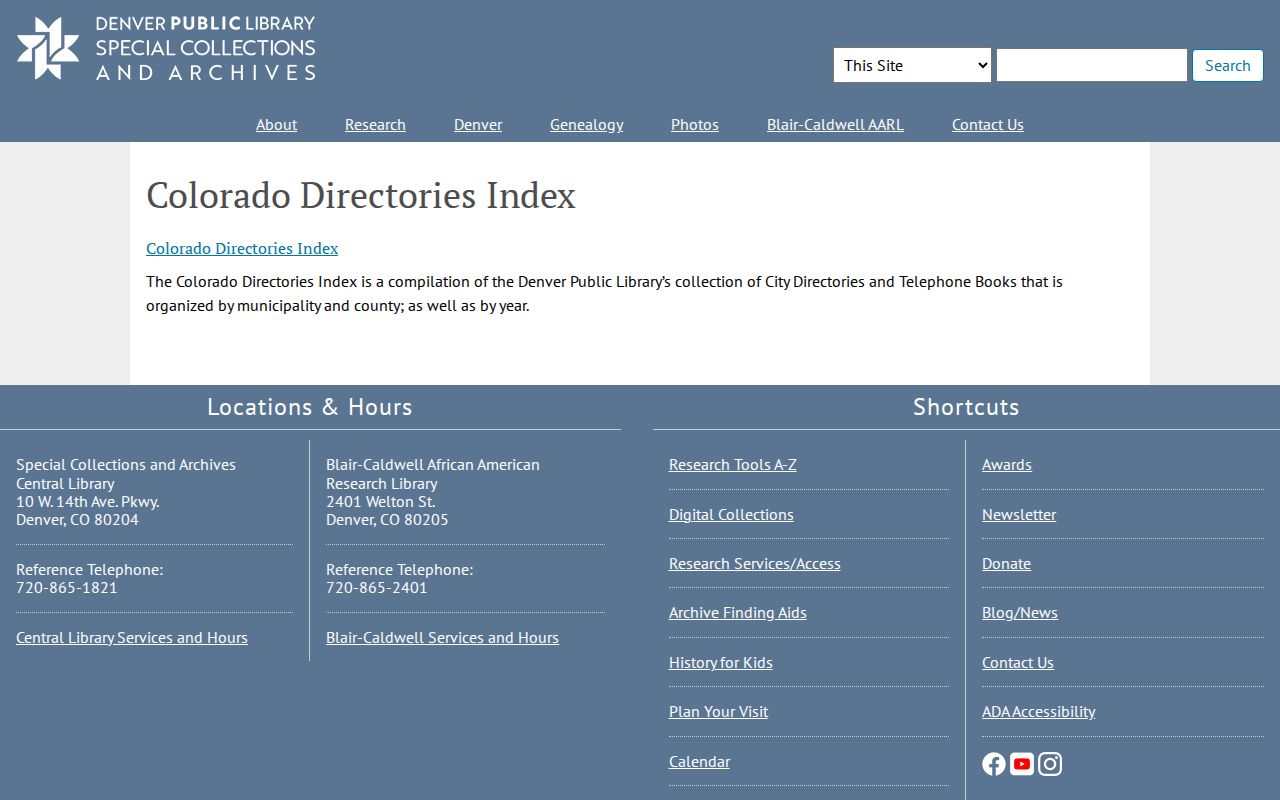
A regional index is only the first step. The image explains why a second pass matters. Find the likely volume first. Then read the actual pages for Castle Rock wording, year, exchange, and address context before you trust the match.
Castle Rock Archive Leads for Directory Research
The Castle Rock Historical Society and Museum operates out of the 1875 Denver & Rio Grande depot at 420 Elbert Street. Hours run Wednesday through Friday, noon to 5 p.m., plus Saturday from 11 a.m. to 4 p.m. Call 303-814-3164. The museum is a strong lead for photographs, family files, business histories, and street or building identifications. Its public pages offer no searchable member or resident directory, so ask staff for a collection-level answer instead.
Colorado State Archives holds older county series that sit naturally beside the historical shelf. Douglas naturalization declarations run 1883-1911, with final documents from 1903-1920 and Justice Court declarations and finals spanning 1870-1890. The Archives also keeps Douglas probate cases from 1865-1945 and district-court divorce records from 1867-1961. A single file can tie together names, relationships, residences, estates, and witnesses. Access and redaction still depend on the record itself.
When an index lead needs a full file, use the probate request guide, the naturalization request route, or a court records request. State the county, the year range, name variants, the record type, and whether you want a copy or a certified copy.
Tracing Castle Rock Directories Across Years
Tracing a household across decades works best as a chain of dated snapshots. Pair the Castle Rock volumes with census years, newspapers, cemetery leads, and a primary record whenever the question truly matters. Federal census material released through 1950 follows a 72-year cycle, and local access depends on the image or index route you choose. A census entry captures a household at one enumeration moment. A dated directory fills the years between those snapshots.
- Set the target person, likely town, and narrowest known year. Keep every spelling and the period street wording.
- Start with the closest DCL newspaper, phone book, or directory issue. Copy the name, role, address clue, issue, page, and collection holder.
- Move one publication year at a time. Mark an appearance, disappearance, new street, business role, or newspaper notice rather than smoothing gaps.
- Pair each directory window with the nearest released census year. Compare names and household relationships, but do not force a match when the place or age conflicts.
- Use an obituary, Cedar Hill lead, probate file, divorce file, or naturalization record as an endpoint. State whether the result is a source fact or a reasoned connection.
A name that vanishes from the volumes may mean a move, a death, an unlisted telephone, a missing issue, or a shift in publication scope. Each explanation is common. Confirming whether someone still lives in town belongs in a separate official record search, such as the Castle Rock resident lookup, not in an assumption that an old listing still describes a living person.
Castle Rock's Record-Survival Timeline
Castle Rock's directory story reads best alongside the town's broader record-keeping history. The residents directory timeline below serves as a research aid rather than proof that a new volume appeared every single year.
| Period | Record-development clue |
|---|---|
| 1874-1875 | County seat moved to Castle Rock after the Douglas and Elbert split; the Denver & Rio Grande depot dates to 1875. |
| 1881-1908 | Castle Rock Journal run documented; the local 1886-1888 business and government directory issues are a special research window. |
| 1908-1952 | Record-Journal provides the next newspaper sequence for names, notices, and civic life. |
| 1952-1966 | Douglas County News continues the local sequence, with gaps and a digital run ending in mid-1966. |
| 1966-1974 | DCL phone books begin a local 1966-1973 window; Library of Congress regional volumes include 1970 and 1974. |
| 2019 to present | DCL's searchable catalog improves discovery while microfilm, reading-room help, and archival requests remain part of access. |
Use the narrow claim. A dated entry can support a lead for family history, civic history, or house research. Do not turn it into a complete Castle Rock resident list or use a name and address to stalk, harass, or track a living person.